You’ve laced up. You’ve found your pace. Now you’re in a full sprint.
That’s exactly what Phase 2 of the Design Sprint feels like.
After assembling your team and navigating the initial steps, this is the part of the Sprint where you have to stay focused, communicate clearly, and trust your teammates. Just like in a relay, everyone’s contribution counts, and collaboration makes all the difference.
Have you ever heard of the African proverb, “If you want to go fast, go alone; if you want to go far, go together”? This quote applies directly to the Sprint. If your team is aligned and unified, you will achieve great solutions together.
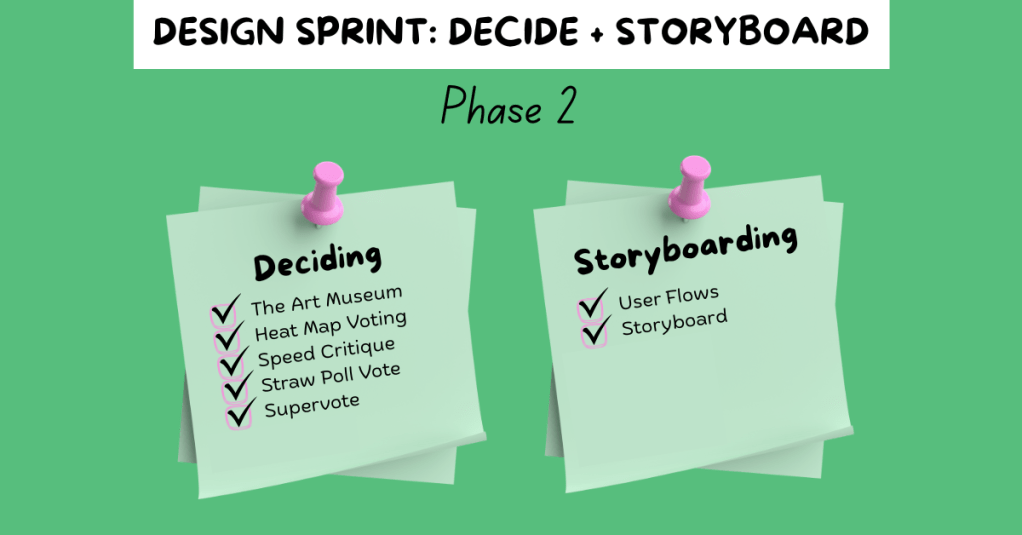
Phase 2 of the Design Sprint, Decide and Storyboard, is all about making critical choices and beginning to shape your final solution. You evaluate the ideas generated in Phase 1 and decide which ones are worth turning into a prototype. In Sprint: How to Solve Big Problems and Test New Ideas in Just Five Days, Jake Knapp, John Zeratsky, and Braden Kowitz describe the steps of this phase:
“You’ll critique each solution, and decide which ones have the best chance of achieving your long-term goal…you’ll take the winning scenes from your sketches and weave them into a storyboard: a step-by-step plan for your prototype.“
Jake Knapp, John Zeratsky, and Braden Kowitz
Let’s break it down.
Step One: Decide
Everyone has strong ideas, and that could make the idea voting process tricky. Luckily, Pattie Belle Hastings, in The Sprint Handbook: A Step-by-Step Guide to Planning and Running Innovation Sprints, offers a clear, structured path to voting on solutions:
The Art Museum
Think of your sketches like artwork on display. Pin your 4-Step Sketches from Phase 1 and observe them silently, just like how you would walk through an art gallery. This will give your team members time to analyze each idea individually before jumping into discussion.
Heat Map Voting
Distribute a sheet of red dots to your team members so they can mark parts of the sketches they found promising and interesting. Hastings suggests voting based on:
- Feasibility
- Desirability
- Impact
- Alignment with project goals
After voting, it is important to discuss the ideas that received the most votes. Ensure each team member has a chance to speak and share their thoughts.
Speed Critique
With a timer set for each idea, have your Facilitator walk the team through each concept and capture key takeaways on three or four sticky notes per idea. This step will allow your group to highlight the strengths and potential concerns of each sketch without going off-track.
Straw Poll Vote
Each teammate should then select their favorite concept and write down the reason why they chose that idea. This will help visualize the group’s preferences and concept popularity.
The Supervote
The final decision is in the hands of your team’s Decider. This exercise should be given a defined time frame, and the Decider will vote using two dots. The votes can be distributed in a few ways:
- Both dots on one concept.
- One dot on a concept, and another dot on a specific feature from another concept.
- Both dots on two different concepts.
Step Two: Storyboard

When the concepts are selected in the Decide stage, it’s time to visualize how your future prototype would function step by step.
Hastings, Knapp, Zeratsky, and Kowitz suggest to start with User Flows, a six-step process outlining user actions like taps or clicks. Each team member should create their own user flow by defining the first and finals actions and then filling in the middle steps. The group then votes on the flow that they want to move forward with.
From there, your team will convert the winning user flow to an 8-screen storyboard, crafting a visual guide to illustrate the user’s journey.
“Storyboarding is a simple process, with a ton of tiny decisions along the way…Every decision you make now is something you won’t have to think about when you build your prototypes.”
Jake Knapp, John Zeratsky, and Braden Kowitz
Along with the visuals, write simple, clear captions beneath each screen describing how the user will interact with your product. This will help your group stay aligned and will be beneficial in the next phase of the Design Sprint.
Team Reflection: Our Decide and Storyboard Experience
This week, my team met over Zoom to work through the Decide and Storyboard phase for our Gen Z personal finance app. We came prepared. Everyone completed their user test flows and reviewed each other’s sketches beforehand. This prep made a huge difference and allowed us to use our time together efficiently.
In the meeting, we:
- Used the Heat Mapping, Straw Poll Vote, and Supervote exercises to identify our top features.
- Set timers to keep our discussion focused.
- Made time for critique, clarification, and team input.
- Spent time refining our storyboard collaboratively.
To view my team’s work from this week, click here.
Final Thoughts
Pattie Belle Hastings sums up the importance of this phase in the Design Sprint: “This is a pivotal moment in the Sprint that transitions the team from decision-making to prototyping. It’s important to end this day with clarity and focus.”
The Decide and Storyboard Phase is where your team’s ideas begin to take shape. It’s where rough sketches transform into plans, and where individual creativity blends into shared vision. In terms of our race analogy, this is the mile marker where momentum builds, and the finish line starts to feel real.
Here are a few takeaways from this phase:
- Communicate early and often. When ideas aren’t clear, ask questions.
- Be flexible. If a vote doesn’t go your way, stay open and engaged.
- Give ideas time to breathe. Sketching, reviewing, and refining takes time, and that’s okay.
We’re not just running anymore; we’re sprinting with purpose.
Stay tuned for Phase 3, where we’ll bring our ideas to life in the Prototype stage.
 Christian Schaaf's Blog + Portfolio