
In today’s digital landscape, data should inform every smart marketing decision. In The Marketing Campaign Playbook, Sharon Lee Thony explains that the right data allows brands to personalize content and adjust campaigns in real time. When ads are tied to clear objectives and measured properly, marketers can improve performance and maximize return on investment.
For this audit, I analyzed a TikTok ad from the Pet Household Products industry promoting the Litter-Robot 5, a self-cleaning litter box by Whisker. Below is the ad.
Campaign Objective: Conversions
The objective of this ad is conversions. The goal is for users to click the link and purchase the product.
Because this is a conversion-focused campaign, the most important metrics include:
- Click-Through Rate (CTR)
- Conversion Rate (CVR)
- Cost Per Click (CPC)
- Cost Per Acquisition (CPA)
In Social Media ROI, Olivier Blanchard examples that measurable business objectives give purpose and direction to campaigns. In this case, success is not just engagement; it is conversions.
Evaluating the Creative Elements
Visuals and Storytelling
The ad is a 14-second short-form TikTok video. It opens with a calm winter morning scene. The woman walks through her home, pours a drink, and sets a peaceful tone. Her cat appears at 6 seconds, and the Litter-Robot 5 appears at 8 seconds.
The setting is warm and relatable. It reflects a slow, quiet morning routine. When the creator says, “When one part of my routine takes care of itself, it makes everything else easier,” she connects the product to convenience and stress reduction. The message is clear: the Litter-Robot simplifies daily life.
Visually, the product is shown in action, which helps viewers imagine how it would fit into their own homes. Showing the product in use is important for a conversion campaign because it reduces uncertainty and builds trust.
This is an example of user-generated content. It feels natural and authentic instead of overly polished or sales-focused. That authenticity likely helps drive the high conversion rate.
Caption and Copy
The caption reads: “Slow mornings, warm coffee, and a simplified routine thanks to @Litter-Box.”

The caption matches the calm tone of the video. It reinforces the idea of ease and simplicity. However, it does not strongly highlight key product benefits such as:
- Self-cleaning technology
- Odor control
- Time savings
- 3-year warranty
Because this is a conversion-focused campaign, the caption could include one clear benefit or value statement to strengthen purchase intent.
Call-to-Action (CTA)
The CTA is subtle. It does not directly say “Buy Now.” Instead, it relies on the visual storytelling and the link to the landing page to drive action.
The landing page itself is strong. It includes:
- The product name and price
- Product images and video
- Feature breakdowns
- Benefits explanation
- A cat acclimation guide
- A 3-year warranty
- An “Add to Cart” button
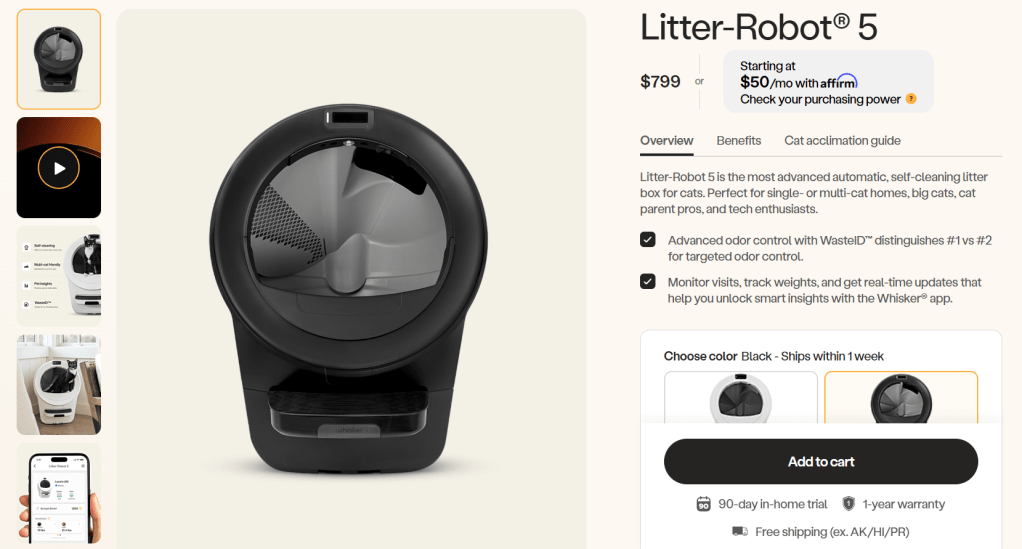
This creates a smooth transition from TikTok to purchase. The page supports the conversion objective well through providing clear information about the product that can be viewed without scrolling. The most important information, like the price, name, description, and “Add to cart” button, are all easy to locate and navigate.
Assessing Targeting Assumptions
The ad likely targets:
- Cat owners
- Tech-forward pet owners
- Busy professionals
- Families with limited time
- Higher-income households (due to premium pricing)
- People who have purchased pet products online
Because this is a higher-priced product, targeting likely focuses on users who are comfortable with online purchases and premium pet care solutions.
Performance Analysis
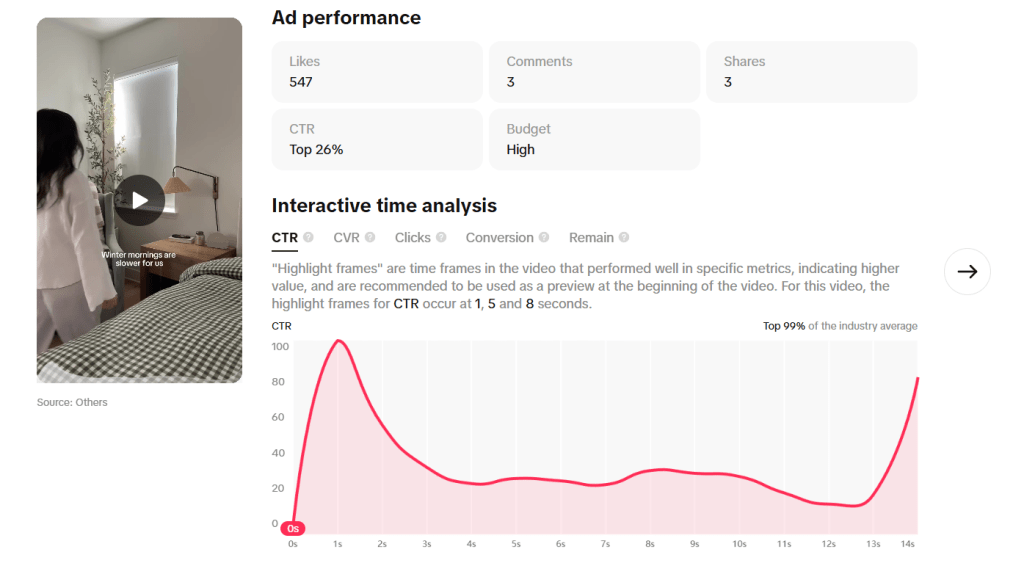
The ad performed in the top 99% of the industry average across CTR, CVR, Conversions, and Retention benchmarks.
Click-Through Rate (CTR)
- CTR peaked at 100 at 1 second.
- It leveled between 20–40 from seconds 3–13.
- It spiked again to 81 at 14 seconds.
This tells us that the hook is strong. Users are clicking early. The spike at the end suggests some users wait until they see the product fully before clicking.
However, the steady decline between 3–13 seconds shows the middle portion may lose urgency.
Conversion Rate (CVR)
- CVR peaked at 100 at 6 seconds (when the cat appears).
- There was also a spike at 1 second.
- This performance ranks in the top 99%.
This is extremely strong. The appearance of the cat clearly drives action. Emotion plays a major role in conversion behavior.
Click and Conversion Timing
- Clicks peaked at 1 second.
- Conversions peaked at 1 second and again at 6 seconds.
- There were 33 conversions at 6 seconds (cat appearance).
This suggests two powerful moments:
- The opening hook
- The moment the cat walks across the screen
Retention
Retention dropped sharply after 1 second and stayed low for the remainder of the video. Even though this ranks high compared to benchmarks, the drop-off suggests viewers could lose interest quickly.
For a conversion campaign, this is important. If most viewers drop off early, the message must deliver product value faster.
Benchmark Context
According to pet industry benchmarks, average CTRs and conversion rates vary based on competition and seasonality. The pet industry often sees strong engagement because pet content is emotional and relatable.
Since this ad ranks in the top 99% across metrics, it is performing exceptionally well compared to industry averages. However, strong performance does not mean it cannot improve.
What Is Working?
- Strong early hook
- Emotional connection when the cat appears
- High CTR and CVR
- Clear landing page experience
- Relatable storytelling
Areas for Improvement
- Sharp retention drop after 1 second
- Product appears slightly late (8 seconds into the video)
- CTA could be clearer for a conversion campaign
Optimization Plan
1. Move the Cat to the First Second
Data Insight:
- CVR peaked at 6 seconds (value of 100) when the cat appeared.
- Conversions also spiked to 33 at 6 seconds.
- Retention dropped sharply after the first second.
This tells us that the cat drives emotional engagement and purchase behavior.
However, many viewers are dropping off before reaching the 6-second mark. That means a portion of the audience never sees the moment that drives conversions.
Optimization Strategy:
Place the cat in the first second of the video or in the thumbnail.
Why This Matters:
If the emotional trigger happens earlier, more viewers may stay engaged and convert before scrolling away. This aligns with the conversion objective because it increases the likelihood that users experience the highest-performing moment.
2. Introduce the Product Earlier in the Video
Data Insight:
- Clicks peaked at 1 second.
- The product does not appear until 8 seconds.
- Retention remains low after the first second.
This means users are deciding whether to click before fully seeing the product benefits.
Optimization Strategy:
Test a version where:
- The Litter-Robot appears within the first 2–3 seconds
- The value proposition (“one less thing to think about”) is stated earlier
Run this as an A/B test against the current version.
Why This Matters:
For a conversion campaign, viewers need to quickly understand what is being sold and why it matters. If retention is low, the message must be delivered faster.
3. Strengthen the Call-to-Action for Conversions
Data Insight:
- CTR and CVR are strong.
- The CTA is subtle and does not create urgency.
Because the objective is conversions, the ad could push slightly harder toward action.
Optimization Strategy:
Test stronger but still tone-aligned CTAs such as:
- “Upgrade your cat care today.”
- “Simplify your mornings now.”
- “Tap to see how it works.”
This can be tested through caption variations or on-screen text.
Why This Matters:
According to Social Media ROI, measurable business objectives require purposeful messaging. If the goal is purchase, the CTA should clearly support that action. The current CTA fits the calm tone, but adding light urgency may increase conversion volume without sacrificing brand voice.
Final Thoughts
This ad is already performing at a high level. It ranks in the top 99% across key metrics and aligns well with its conversion objective.
Optimization is an ongoing process. By aligning metrics with objectives, monitoring performance data, testing creative variations, and refining targeting, brands can continue to improve ROI.
Data does not just tell us if an ad is good. It tells us how to make it better.
 Christian Schaaf's Blog + Portfolio