Need to pitch your product idea and don’t know where to start? You’ve come to the right place! I recently took on the challenge of researching digital products and then creating a pitch to help decide which idea I should move forward with. If you’re curious about my research process, you can check out my last blog post.
When it came time to pitch, I had all the same questions you might be thinking: How do I structure my pitch? What makes a pitch effective? How do I condense my research into just a few minutes? Through trial, error, and a lot of practice, I learned a few valuable tips that made the process smoother. Let’s dive in.
Creating a Presentation
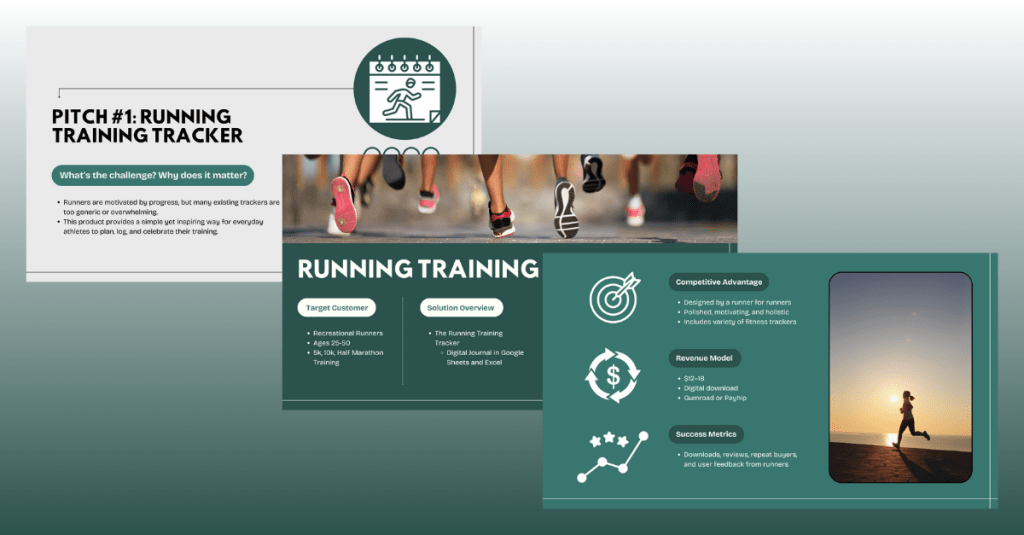
In the article “How to Successfully Pitch Your Business Idea to Investors,” Caroline Cummings suggests starting with a presentation. A clear and simple pitch deck can keep you on track and highlight the most important points. I took that advice and created a slide deck that walked through my product ideas. It helped me get organized, and that made all the difference.
I also wrote a script in addition to the slides, and this helped me gather my ideas in a concise way. A script is like your safety net: it makes sure you do not forget any key details while also keeping you from rambling. You want to get to the point quickly, but you also want to be thorough. There are even templates on Canva and Google Slides if you need inspiration. Click here to view my slide deck for reference.
Structuring the Pitch

Cummings also stresses the importance of outlining the problem and then offering a compelling solution. That advice was echoed by Pattie Belle Hastings, who provides a simple outline for creating an effective pitch:
- Problem Statement: What specific problem does this solve?
- Target Customer: Who exactly needs this solution?
- Solution Overview: What are you building?
- Key Features: What are the 3–5 main features of the product?
- Competitive Advantage: Why will customers choose this over alternatives?
- Revenue Model: How will you monetize, and what platform will you use?
- Success Metrics: How will you measure success?
I used this exact outline, and it kept me focused. It also made my pitch easy to follow for the audience.
Practice Makes Progress
The next tip is one that cannot be stressed enough: practice your pitch. I rehearsed my script several times, timing myself to make sure I stayed within my three-minute limit. Practicing helped me simplify my message and cut out anything unnecessary.
If you are recording your pitch, tools like Loom are a lifesaver. Even if you are presenting live, practicing with a recording tool can help you see how you sound and where you might stumble. Watching yourself back can be uncomfortable, but it is incredibly useful for improving your delivery.
Check out my product pitch video below.
The Power of Feedback
Another big part of the process is feedback. After presenting my pitch, my colleagues shared what they thought about each product. The votes on my three product ideas were split almost evenly, which made the feedback even more valuable.
For the Running Training Tracker, they said I bring a lot of passion and knowledge to this idea because of my experience as a distance runner. One classmate pointed out, though, that some people might prefer existing apps like Strava instead of a tracker.
For the Event Kits, which included flyer and social media templates, my classmates agreed there is a strong market for small business owners who do not have a design background. One person suggested making sure the kits stand out by emphasizing what unique value they provide.
For the Brand Kits, classmates noted that tailoring them to a specific audience, like solopreneurs, coaches, and nonprofit managers, would help them stand out from generic branding templates already on the market.
My Decision
It was tough to choose because I feel a personal connection with all three products. The running tracker connects to my passion for running. The flyer and brand kits tie into my professional work in design and communications.
After thinking it over, I decided to move forward with the Running Training Tracker. I plan to position it as a more personal and customizable tool, different from the social-sharing and data-heavy platforms like Strava. My version will focus on helping runners stay motivated and track progress in a way that feels encouraging and personal rather than overwhelming.
Key Takeaways
If you are preparing your own pitch, here are the biggest lessons I learned:
- Keep it concise and organized.
- Follow a clear outline: problem, solution, customer, features, revenue, and success metrics.
- Practice until the message feels natural.
- Ask for feedback and refine your pitch, even if you think it is already solid.
Most importantly, remember that pitching is a skill. The more you practice, the better you will get.
Wrapping Up
This experience taught me that pitching is not about perfection. It is about clarity, confidence, and connecting with your audience. Whether you are pitching to investors, classmates, or future customers, keep refining your message and believe in the value of your idea.
I am excited to keep developing my Running Training Tracker and to see how it evolves. Best of luck on your own pitching journey. You’ve done the research, and now it is time to share it with the world. You got this.
 Christian Schaaf's Blog + Portfolio