Tag: Creativity

  • Lessons From the Peaks: What I Learned Creating a Passion Project

    Lessons From the Peaks: What I Learned Creating a Passion Project

    Getting the chance to do a passion project is a privilege. You get to dive into research on a topic you care about, create work in a medium you choose, and let your creativity lead the way. Your canvas is entirely your own.

    For me, that meant merging two things I care deeply about: national parks and preservation with my love for design. That’s how my campaign, Preserve the Peaks, an educational project about Rocky Mountain National Park that encourages visitors to enjoy the park responsibly, came to life. It has been an exciting journey, and I learned some lessons while working on this project worth sharing.


    Creating Content Takes Time

    If I had to pick one key lesson, it’s this: creating content takes time. More time than you expect. To truly meet your goals, you have to dedicate enough time for every phase: research, planning, production, and post-production.

    If you think something will take five hours, give yourself ten. Projects always demand more than you think. But here’s the good news: when you’re invested in the process, the time doesn’t feel wasted. Even though the work was time-consuming, I enjoyed every step because I believed in the project.


    Keep Track of Everything

    This project was my first time using a project management system, and I chose Trello. It completely changed the way I worked. I tracked every step, from the tasks I completed to the time each one took.

    Not only did this help me stay on schedule, but it also gave me insight into my workflow. Now I know how long it really takes me to research, draft, design, and polish content. That’s knowledge I’ll carry into every future project.


    Be Flexible: Things Will Change

    No matter how well you plan, your final project will almost never look exactly like the idea you started with. And that’s okay.

    At the beginning of Preserve the Peaks, I thought I was going to create only an interactive posters in Genially. Once I explored the platform, I realized I could build something bigger and more interactive: a game where visitors test their knowledge of responsible park practices. That change made the project more fun and more impactful.

    The lesson? Be open to change. Don’t shut down an idea before you’ve explored it. Sometimes those unexpected turns make your project stronger.


    Planning is Your Best Friend

    When life gets busy, it’s hard to carve out big chunks of time for creative work. That’s why planning is so important.

    I broke my project into small, actionable tasks that I could check off, even if I only had fifteen minutes to spare. Over time, those little steps added up to big progress. Trello made this process smooth, but any system that works for you will do the job. The key is having a plan and sticking to it.


    Have Fun

    At the end of the day, the most important part of a passion project is the joy it brings. You have the opportunity to explore an idea that excites you, so lean into it. Embrace each step, let yourself get lost in the creative process, and enjoy the ride.

    To see the full process behind Preserve the Peaks, check out my case study here.


    Final Thoughts

    Whatever project you choose to embark on, embrace it fully. Be open to change, manage your time wisely, plan your steps, and most importantly, have fun with it. Your passion deserves the time and care it takes to bring it to life.
  • Unlocking Creativity: Exploring the Ideation Phase in Design Thinking

    Unlocking Creativity: Exploring the Ideation Phase in Design Thinking

    Creating an App: The Beginning Phase

    This week, I was presented with a thought-provoking question: How do you create an app? And where do you start? As part of my graduate class on Ideation, Prototyping, and Testing, I was challenged to explore the beginning stages of app development. Until now, I had never considered creating my own app. Faced with this creative challenge, I wondered: Where do I begin?

    I started by diving into the Ideation phase of the Design Thinking Process. This stage is all about generating ideas – the good, bad, and everything in between – to identify potential solutions to a problem. Through research, I discovered various Ideation techniques, including Brainstorming to Worst Possible Idea to Mind Mapping, and more. Ultimately, I decided to experiment with three techniques: Braindumping, Mind Mapping, and Sketchstorming. Here’s how each method shaped my app idea.

    My Ideation Phase of Creating an App

    Braindumping: Getting Every Idea on the Table

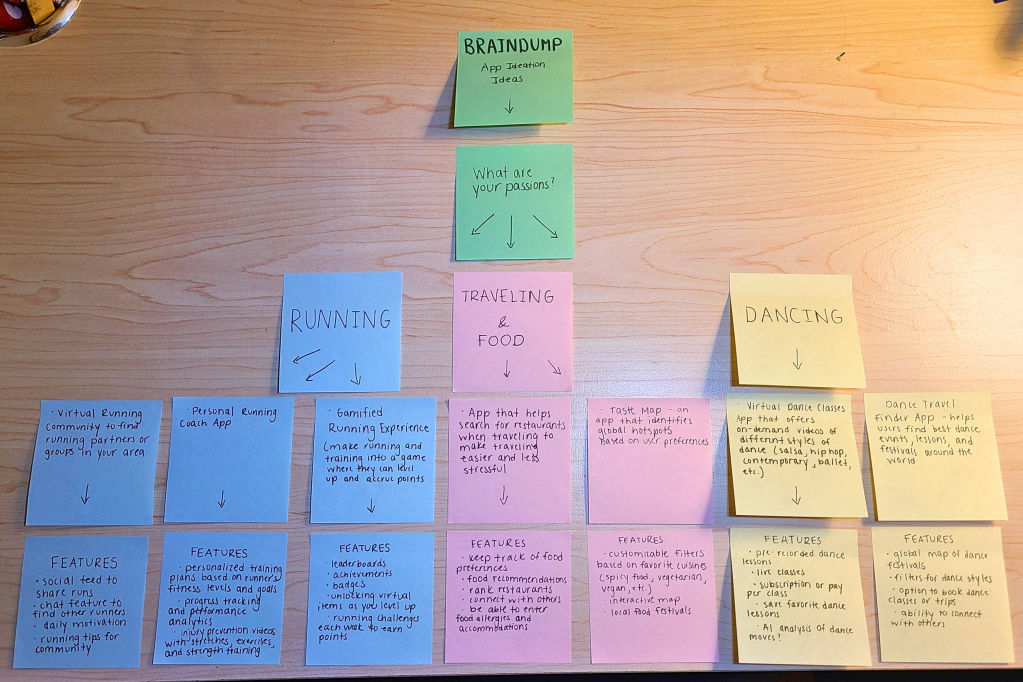
    I began with Braindumping, a technique that involves writing down ideas freely without judgment or filtering. Using sticky notes, I jotted down responses to key questions: What are my interests? What do I look for in an app?

    This exercise helped me identify four core interests: running, traveling, food, and dancing. I then brainstormed potential apps for each category.

    • Running: A platform to connect with local runners or a personal coaching app.
    • Dancing: A virtual dance studio offering live and pre-recorded lessons.
    • Traveling & Food: An app that helps users find restaurants based on dietary preferences and allergies.

    One idea resonated with me the most: an app that combines food and travel to help users find restaurants based on dietary restrictions. This concept stemmed from a personal experience with my mom; she follows a gluten-free diet and often struggles to find suitable dining options. With this in mind, I moved to the next phase: expanding the idea through Mind Mapping.

    Mind Mapping: Structuring the Concept

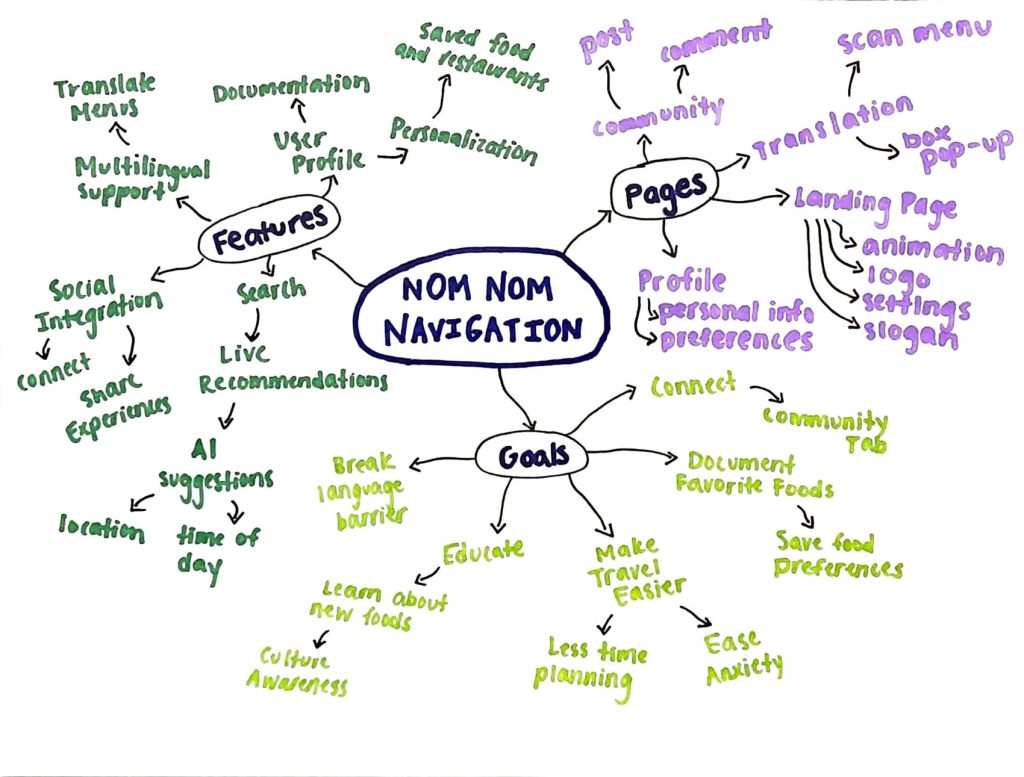
    To further develop my idea, I created a Mind Map, a technique where a central theme branches out into subtopics and related concepts. At the center of my map was the core idea: A restaurant-finding app for dietary preferences. From there, I created branches to explore the app in more detail:

    • App Features
    • Pages/Tabs
    • Goals

    Mind Mapping allowed me to see the app’s potential features at a glance, providing clarity on what to include in some potential mockups. This led me to explore the Sketchstorming technique.

    Sketchstorming: Bringing the Idea to Life

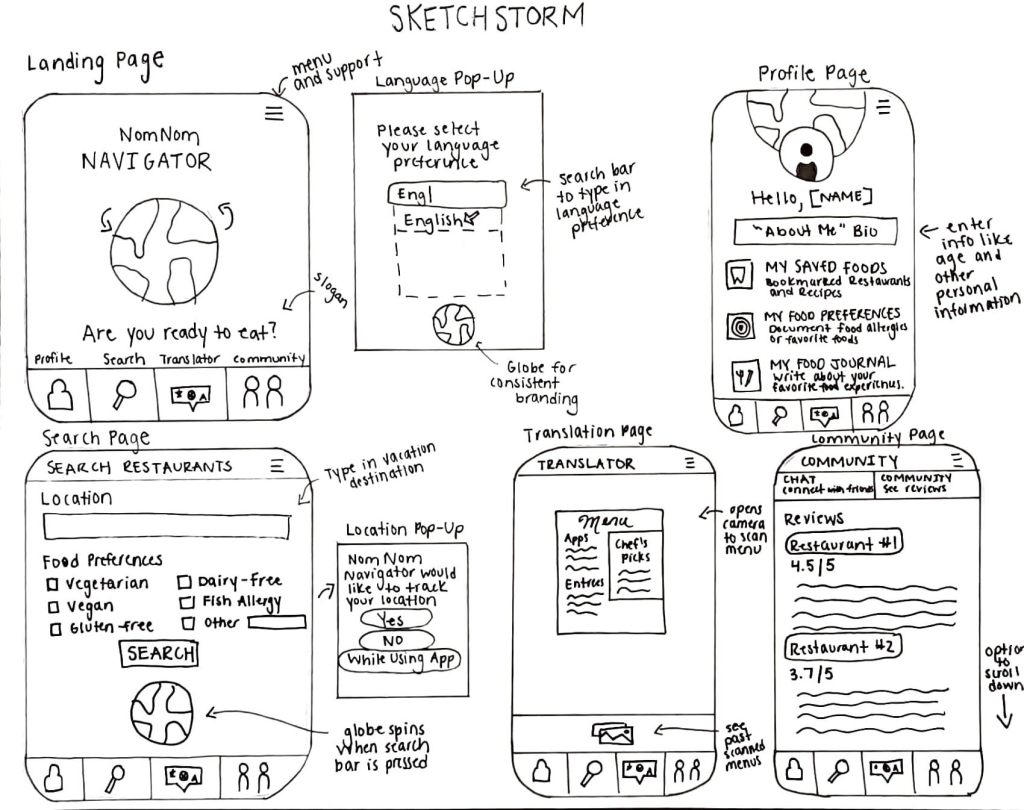
    Sketchstorming involves quick, rough sketches to conceptualize a product’s interface and layout. I began by sketching the app’s landing page and main tabs:

    • Profile: Where users input their dietary restrictions.
    • Search: A customizable restaurant-finding tool.
    • Translation: A language-assist feature for travelers.
    • Community: A space for users to share restaurant recommendations.

    Sketching helped me visualize the user experience, making the app feel more tangible. I realized that combining ideation techniques – starting broad with Braindumping, refining ideas through Mind Mapping, and visualizing them with Sketchstorming – was instrumental in shaping my concept.

    Reflections and Next Steps

    This was my first time formally using the Design Thinking Process, and it was both challenging and rewarding. By exploring multiple ideation techniques, I gained a deeper understanding of how to refine an idea and bring it to life. Moving forward, I’m excited to continue to study the Design Thinking Process.

    Have you ever used an Ideation technique? I’d love to hear how you approach creative problem-solving!

  • Exploring the World of Creative Possibilities

    Exploring the World of Creative Possibilities

    From the moment Christian visited The Philadelphia Art Museum as a child, his passion for art was ignited. A trip to the Photography Impressionist Exhibit introduced him to the beauty of landscapes, people, and animals captured through photos, sparking a curiosity that would shape his future interests. He found his love for storytelling and knew that he wanted to pursue a creative career.

    Raised in the small town of Phoenixville, Pennsylvania, Christian explored his artistic interests in high school. His passion for creativity led him to courses in Art and English, where he could express himself both visually and in written form. When he was finishing high school, he did not know the exact creative path to pursue, but he knew that he wanted to blend both art and writing in his future studies and career. He was excited to dive into this next chapter, but this was also daunting since he did not know his exact path.

    Christian continued to explore these interests at Elizabethtown College, where he pursued a double major in Communications and Graphic Design. Taking courses like Visual Communications, Typography, Graphic Arts, Public Relations, and Marketing solidified his choice in pursuing these majors. Christian’s path started to become clearer, and he was eager to learn and become involved in his college’s Communications and Art Departments. His college experience was filled with unique opportunities, including hosting his own radio show, becoming a Journalism tutor, collaborating with a local business to create a company logo, and working as a tour guide in Elizabethtown’s Admissions Office.

    Following graduation, Christian began his professional journey as a Communications Specialist at a special education school and has worked there for the past two years. In this role, he manages the school’s website and social media presence, maintains consistent branding, illustrates student life through photography, and creates promotional materials for the Development Department. Every day presents new opportunities for creativity, whether he’s writing, designing, or photographing moments around campus.

    Looking ahead, Christian hopes to continue down this creative path with dreams of becoming a creative director or design manager in the sports industry. His love for running makes this a very exciting path for him, combining his interest in athletics with his passions for branding, communication, and design. Now pursuing a master’s degree in Interactive Media and Communication, Christian is looking forward to expanding his skillset, building connections, and pushing himself to think more innovatively.