Category: Uncategorized

  • Lessons From the Peaks: What I Learned Creating a Passion Project

    Lessons From the Peaks: What I Learned Creating a Passion Project

    Getting the chance to do a passion project is a privilege. You get to dive into research on a topic you care about, create work in a medium you choose, and let your creativity lead the way. Your canvas is entirely your own.

    For me, that meant merging two things I care deeply about: national parks and preservation with my love for design. That’s how my campaign, Preserve the Peaks, an educational project about Rocky Mountain National Park that encourages visitors to enjoy the park responsibly, came to life. It has been an exciting journey, and I learned some lessons while working on this project worth sharing.


    Creating Content Takes Time

    If I had to pick one key lesson, it’s this: creating content takes time. More time than you expect. To truly meet your goals, you have to dedicate enough time for every phase: research, planning, production, and post-production.

    If you think something will take five hours, give yourself ten. Projects always demand more than you think. But here’s the good news: when you’re invested in the process, the time doesn’t feel wasted. Even though the work was time-consuming, I enjoyed every step because I believed in the project.


    Keep Track of Everything

    This project was my first time using a project management system, and I chose Trello. It completely changed the way I worked. I tracked every step, from the tasks I completed to the time each one took.

    Not only did this help me stay on schedule, but it also gave me insight into my workflow. Now I know how long it really takes me to research, draft, design, and polish content. That’s knowledge I’ll carry into every future project.


    Be Flexible: Things Will Change

    No matter how well you plan, your final project will almost never look exactly like the idea you started with. And that’s okay.

    At the beginning of Preserve the Peaks, I thought I was going to create only an interactive posters in Genially. Once I explored the platform, I realized I could build something bigger and more interactive: a game where visitors test their knowledge of responsible park practices. That change made the project more fun and more impactful.

    The lesson? Be open to change. Don’t shut down an idea before you’ve explored it. Sometimes those unexpected turns make your project stronger.


    Planning is Your Best Friend

    When life gets busy, it’s hard to carve out big chunks of time for creative work. That’s why planning is so important.

    I broke my project into small, actionable tasks that I could check off, even if I only had fifteen minutes to spare. Over time, those little steps added up to big progress. Trello made this process smooth, but any system that works for you will do the job. The key is having a plan and sticking to it.


    Have Fun

    At the end of the day, the most important part of a passion project is the joy it brings. You have the opportunity to explore an idea that excites you, so lean into it. Embrace each step, let yourself get lost in the creative process, and enjoy the ride.

    To see the full process behind Preserve the Peaks, check out my case study here.


    Final Thoughts

    Whatever project you choose to embark on, embrace it fully. Be open to change, manage your time wisely, plan your steps, and most importantly, have fun with it. Your passion deserves the time and care it takes to bring it to life.

  • Crossing the Finish Line: Tips for Reviewing Your Final Project

    Crossing the Finish Line: Tips for Reviewing Your Final Project

    You’ve put in the hours. You’ve done the research. You’ve designed the deliverables. Now, you’re approaching the finish line of your passion project. But before you hit submit, there’s one last step that can make the difference between “good enough” and “wow.” The review process.

    Whether you’re wrapping up a paper, a presentation, or (in my case) a digital guide for a campaign, taking the time to review your final project is what ensures all of your hard work shines. Let’s talk about some best practices for reviewing your project before submission and how I applied them to my Preserve the Peaks campaign.


    Why Reviewing Matters

    It’s tempting to rush at the end of a project. After all, you’re tired, excited, and looking forward to wrapping it up. However, Kingson S in The Documentation Review Process: A Practical Guide notes that reviewing your work is non-negotiable. It’s how you catch the little details that may trip up your audience and make sure your project feels polished.

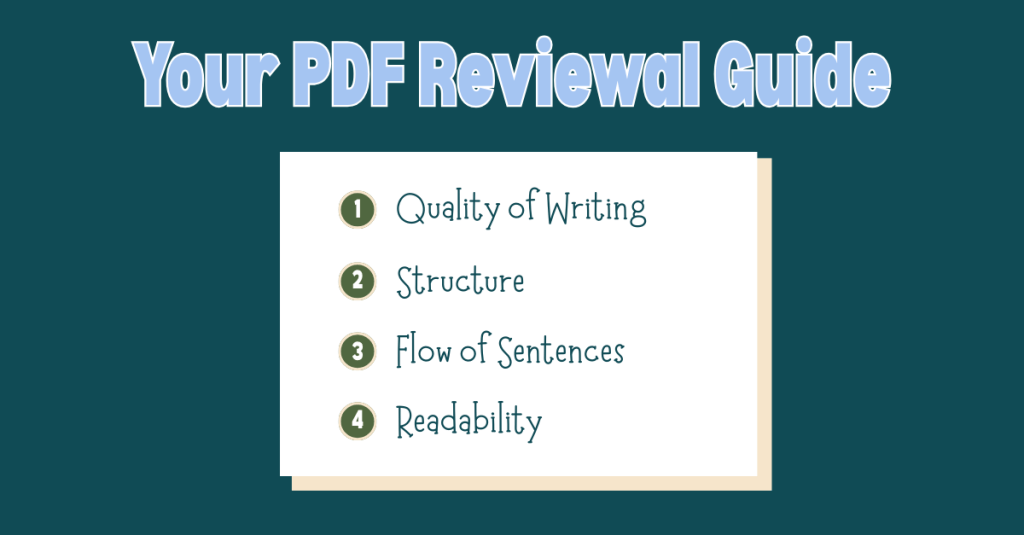
    Kingson points out a few areas to check:

    • Quality of the writing: Make sure grammar, spelling, and punctuation are clean.
    • Structure: Is the information organized logically? If you have a table of contents, double-check it matches the sections.
    • Flow of sentences: Do your ideas connect smoothly? Avoid abrupt stops or choppy transitions.
    • Readability: Is your document written at a level that your audience can easily follow? Tools like the Flesch Reading Ease score can help here.

    In short: clarity and consistency are everything.


    My Review Process

    This week, I wrapped up the final step of my passion project: creating a digital PDF guide for Rocky Mountain National Park as part of my Preserve the Peaks campaign. The guide supplements the first two phases of my project: infographics and interactive content created in Genially. It serves as a comprehensive resource on the park’s history, landmarks, climate challenges, and tips for being a responsible visitor.

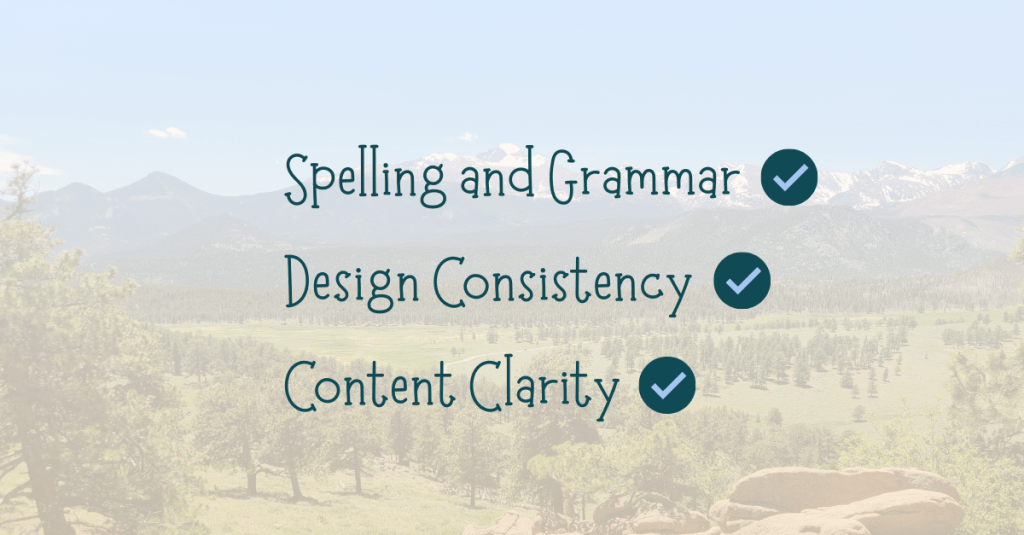
    When I reviewed my PDF, I focused on:

    • Spelling and grammar checks: A small typo can make a big impact, so I read through each section carefully.
    • Consistency in design: Fonts, headings, and colors needed to feel cohesive, not distracting.
    • Clarity of content: Each paragraph had to feel approachable for a wide audience, written at about an eighth-grade reading level.

    It was worth the effort. The final product feels like something I’d be proud to share with both park visitors and fellow designers.

    If you’re curious about how to plan and structure a PDF project like this, check out my previous post on best practices for creating a digital PDF guide.

    To view my Rocky Mountain National Park PDF guide, click here.


    My Tips Before You Hit Submit

    Here are a few lessons I learned that might help you as you wrap up your own project:

    Slow Down and Review

    Don’t treat the review process like an afterthought. Build it into your timeline so you aren’t scrambling at the last minute.

    Get Another Set of Eyes

    Fresh perspectives matter. Ask a friend, family member, or colleague to look at your project. They’ll spot things you might miss after weeks of work.

    Check Against Your Goals

    Ask yourself: does this project achieve what I set out to do? In my case, the goal was to inform and inspire people to visit Rocky Mountain National Park responsibly. Reviewing with that goal in mind helped me cut out extra fluff and keep the focus clear.

    Look at Both Content and Design

    Good design enhances good content. Make sure your visuals support your message rather than overwhelm it.

    Celebrate Your Hard Work

    Finally, remember to enjoy this stage. When you’ve put in so much effort, reviewing isn’t just about catching errors; it’s about appreciating how far you’ve come.


    The Final Push

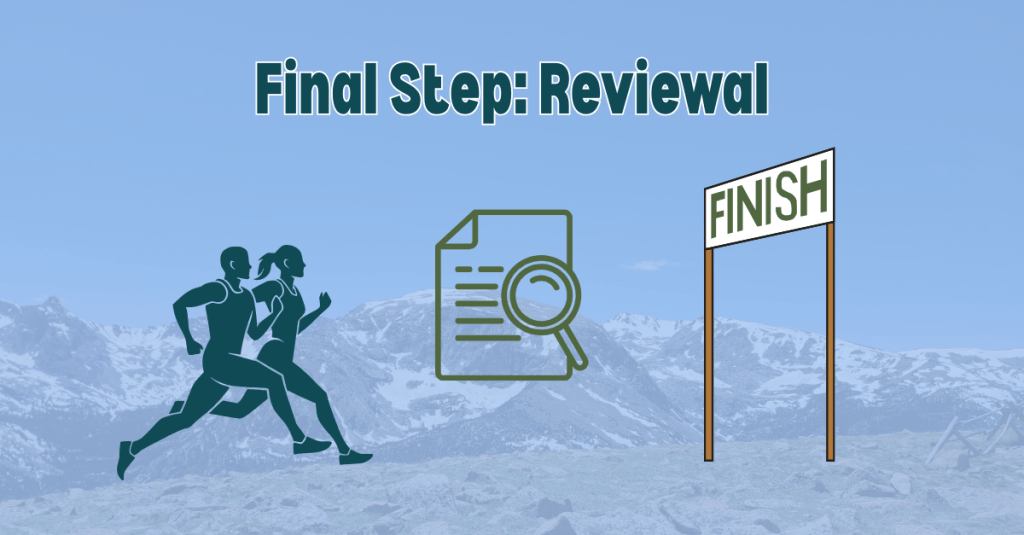
    Finishing a project is a lot like finishing a race. You’ve trained, you’ve paced yourself, and now the finish line is in sight. The review process is your sprint to the line. It’s the last bit of effort that ensures your work stands strong.

    When you do finally hit submit, it will be the best feeling knowing you gave your project the attention it deserved from start to finish. So slow down, take the time to review, and trust yourself. You’ve got this.

    Final Thought: Review, review, review. Your future self will thank you.

  • Under the Algorithm’s Spell: Breaking Free from Social Media’s Grasp

    Under the Algorithm’s Spell: Breaking Free from Social Media’s Grasp

    Do the negative aspects of social media outweigh the positives?

    I was late to the social media game, mainly because my parents encouraged me to stay off the platforms in high school. Looking back, I’m actually thankful they did. It wasn’t until the summer after graduation that I created my first social media account—a rare occurrence in today’s world. The reason? To stay in touch with high school friends as we went to college.

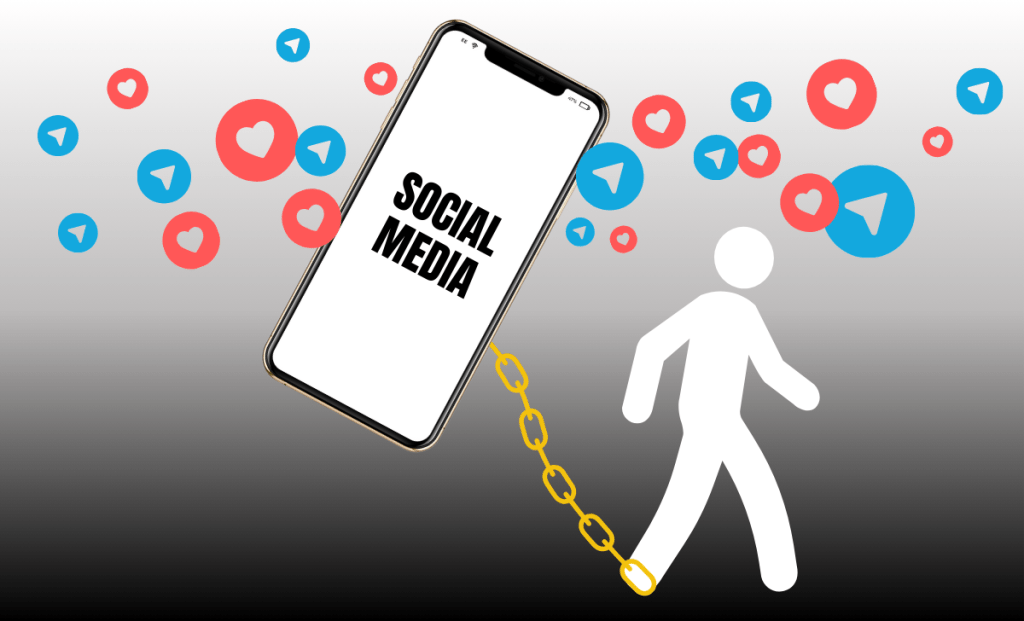
    Since then, I’ve found myself falling into the same social media traps that millions of people experience. During the pandemic, I joined TikTok and quickly found myself scrolling endlessly. Platforms like TikTok are designed to keep us hooked, and the more time we spend on the app, the more we engage with its content.

    The “Foundations of Humane Technology” course from the Center for Humane Technology sheds light on this. It defines “persuasive technologies” as scientifically tested design strategies that manipulate our behavior toward a specific goal, such as spending more time on a website or app. TikTok’s algorithm tracks the content you interact with—videos you like, recent searches—and then curates a feed to keep you scrolling. This might sound harmless, but it’s all part of a larger strategy to maximize user engagement, even if it means hijacking our attention.

    The more I learn about inhumane technology, the more I realize how platforms are intentionally designed to capture and hold my attention. TikTok, for example, delivers an endless stream of content it knows we’ll enjoy – not just to entertain, but to keep us scrolling. It’s a time trap we fall into without even realizing it.

    That being said, there is one feature on TikTok that hints at a step in the right direction—an occasional pop-up that encourages users to take a break after extended periods of scrolling. It’s a nice gesture toward promoting mental health, but from my experience, it doesn’t appear until hours of usage. By then, has the app already achieved its goal of keeping me engaged for as long as possible?

    Overall, I believe technology, especially social media, takes advantage of users to serve its own purposes. Yet, there’s a shift happening. According to the Center for Humane Technology, harmful technologies are no longer getting a free pass. More people are recognizing the value of their attention and pushing back against these manipulative designs.

    The question remains: How long will it take for significant change? While we wait for stronger regulations, we have to take matters into our own hands—setting screen limits, finding other ways to connect with loved ones, and spending more time outdoors. In this fast-paced digital world, taking care of our mental health and protecting our attention has never been more important.

  • Taming the Chaos: How I Find Structure in a Fast-Paced World

    Taming the Chaos: How I Find Structure in a Fast-Paced World

    Does anyone else feel like getting organized is impossible? Like as soon as you finish one task, another one pops up, leaving you feeling like you can never catch a break? Getting organized is tough—sometimes the hardest part is just figuring out where to start. In today’s fast-paced world, it’s easy to lose track of everything—work projects, personal tasks, school assignments. Most of the time, I rely on the old-school method of jotting down tasks in a notebook, especially for work and school. At work, I keep a daily list and check off each task when completed, which always feels satisfying. I did the same during my undergraduate years.

    Recently, I was introduced to digital project management systems, tools designed to plan and organize projects more efficiently. As a visual learner, I knew I wanted a system that would not only help me stay organized but also present my projects in a creative, visually appealing way. After exploring options like Asana, Podio, and Trello, I decided to go with Trello. It stood out because of its customizable visual interface—who doesn’t love fun colors and images?

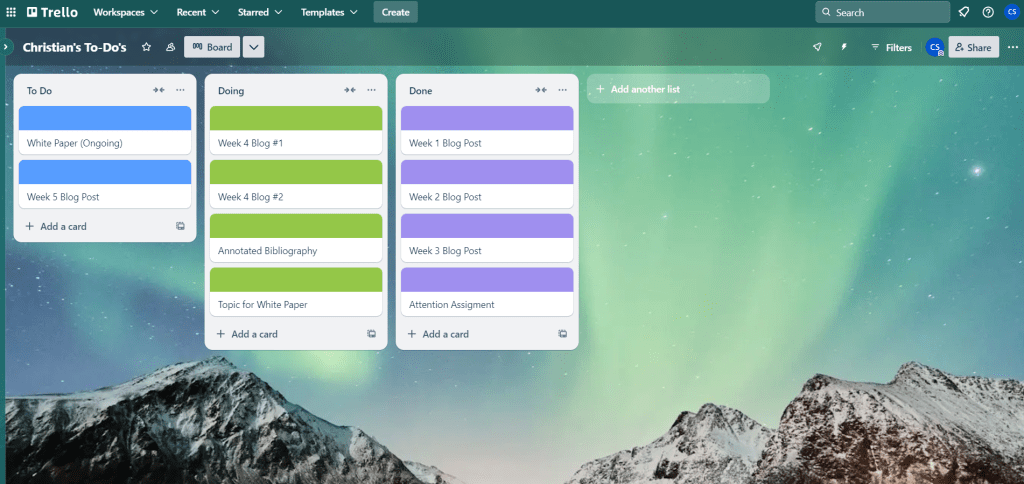
    When I set up my Trello board, I used a simple structure with three sections: To-Do, Doing, and Done. This method allows me to see what I’ve already accomplished, focus on the most pressing tasks, and plan for the future. This structure keeps me from feeling overwhelmed, as it helps me focus on one task at a time. Instead of jumping between multiple projects and draining my mental energy, something Johann Hari discusses in Stolen Focus: Why You Can’t Pay Attention – and How to Think Deeply Again, I tackle each task one by one.

    Because I’m a designer and love working with color, I customized my Trello board using my favorite colors to visually break up each section. For the background, I chose an image of the Northern Lights, which speaks to my love for nature and the outdoors. Incorporating these elements made the system feel more personal and enjoyable to use. So far, I’ve set up my board to organize my school tasks, but I plan to expand it to include both work and personal projects as well.

    I’m also applying a key piece of advice from Jennifer Whitt, Director of ProjectManager.com, who talks about the importance of collaboration at every stage of a project, from brainstorming to execution. Once I expand my Trello board to include work-related tasks, I plan to share it with my boss and co-workers so they can stay updated on my current workload. This way, as a team, we can hopefully stay organized and complete our work in a more efficient way.

    Getting organized is the hard part, but once everything is in place, it makes a world of difference. This is a great beginning step, and I’m excited to continue to explore other ways to organize my daily tasks.

  • From FOMO to Focus: How I’m Learning to Manage Stress

    From FOMO to Focus: How I’m Learning to Manage Stress

    Stress is everywhere. In a society that often glorifies constant productivity, appearances, and staying busy, it can feel impossible to slow down and enjoy the moment. With technology feeding us a constant stream of information, reducing stress can be a real challenge. Personally, I struggle with putting my phone down, afraid of missing out — the FOMO is real. So, the question becomes: how can we effectively manage stress in today’s world?

    Johann Hari, in Stolen Focus: Why You Can’t Pay Attention – and How to Think Deeply Again, discusses his own battle with stress and how disconnecting in Provincetown helped him regain control of it. He talks about how our surroundings and the people in our lives can significantly impact our stress levels. Dr. Nadine Burke Harris, in her research and work in pediatrics, emphasizes the importance of feeling safe to focus effectively. She explains that in secure environments, our minds can switch off distractions and dive deeply into a single task. Similarly, Dr. Jon Jureidini, a child psychiatrist in Adelaide, Australia, states that our minds can only relax when we feel safe. When we sense danger, even subconsciously, our minds become hypervigilant, always on the lookout for potential threats.

    I can relate to this as I think back to my own childhood. When I was younger, I could easily spend hours completely focused on one thing—whether it was drawing an entire neighborhood in my driveway with chalk, complete with intersections and unique house designs, or building a town out of blocks. My mom used to say that during the holidays, it would take me days to open all my gifts. I’d open one present and play with it for hours before even thinking about the next one. That level of focus was possible because my environment was free from stress.

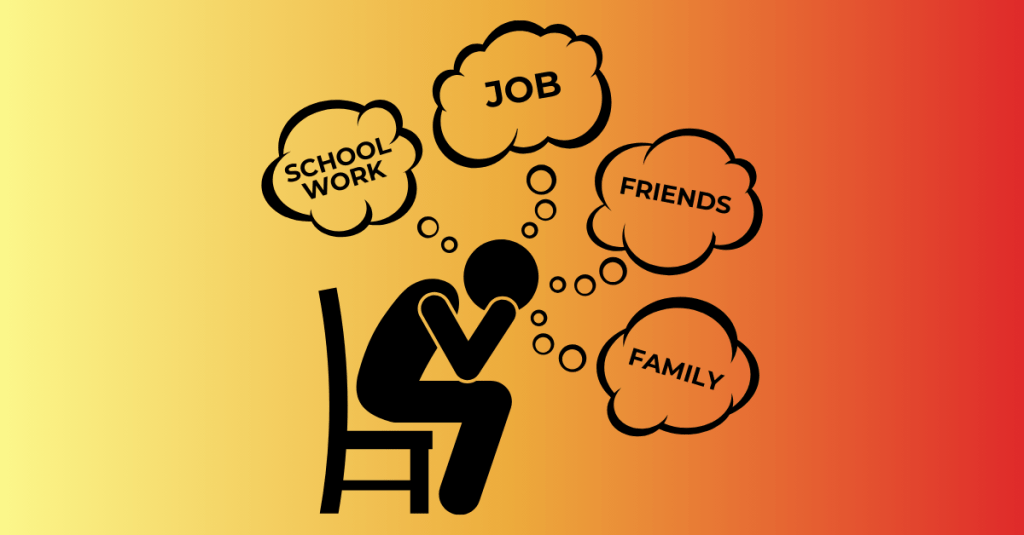
    As an adult, things are different. Juggling multiple responsibilities—working full-time, attending grad school part-time, managing finances, maintaining relationships—takes a toll. It’s no wonder my attention span has decreased; there’s just more to handle now. I could focus so well on drawing those neighborhoods in my driveway because I didn’t have the stress that comes with adult life.

    So, how do we manage stress as adults? In my experience, it’s much harder than it was when we were kids with fewer responsibilities. I’ve learned that when we’re in a safe, comfortable environment, we can try to adopt Dr. Harris’s approach: focus on one thing at a time. When I manage to do this, it works most of the time. It can still be difficult to stay focused on just one task. In those moments, I believe we should try to control the distractions within our reach. Put the phone, the watch, the other technology aside, and give yourself permission to be fully present with whatever you’re working on. When we do that, our stress levels might just take a dip.

  • Doom Scrolling to Strolling: My TikTok Detox

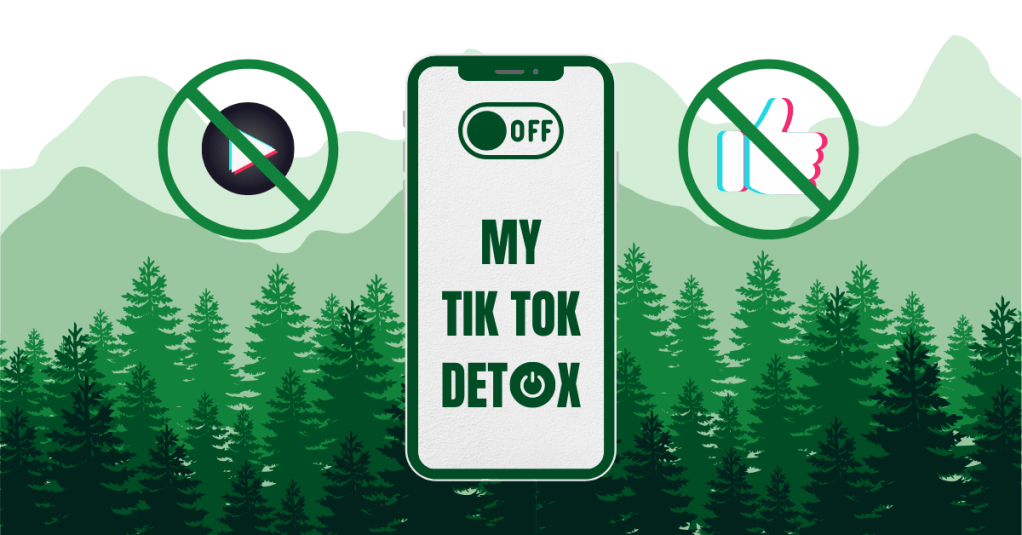
    Doom Scrolling to Strolling: My TikTok Detox

    Giving up something in your daily routine is always a challenge. We’re creatures of habit, and, let’s be honest, change is tough. In a world that’s increasingly digital, we rely on our screens for connection, entertainment, and distraction. I know I do. So, this week, I gave up my favorite social media platform: TikTok.

    Before diving into the experiment, I did what no one ever wants to do: look at their screen time. TikTok was my most-used app—by far. I wasn’t surprised. I love the creativity that TikTok brings to my feed—new recipes, travel inspiration, incredible artwork. But, like many of us, I’ve fallen victim to the infamous “doom scrolling.” What starts as 15 minutes can quickly turn into two hours of endless swiping. I thought to myself, “can I actually give up TikTok…and survive?”

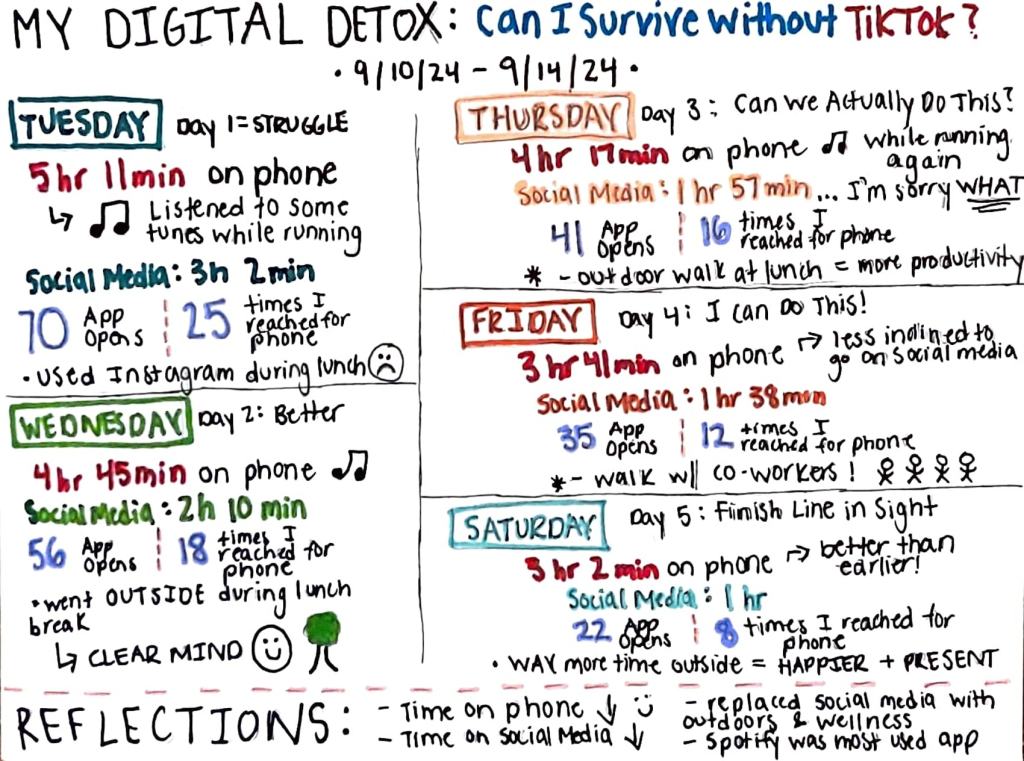
    For a week, I tracked two types of data: behavioral and emotional. On the behavioral side, I focused on how many times I reached for my phone, how long I spent on it, which apps I opened, and what I did to replace TikTok. Emotionally, I tracked how I felt each day, how productive I was, and whether I felt more present in my daily life.

    Before starting the experiment, I reviewed my last three weeks of phone usage. In total, I spent 80 hours on social media—about 26-27 hours per week. TikTok accounted for 42 of those hours, averaging 14 hours a week. I was captivated by TikTok like a bug is drawn to light, but this was a wake-up call. I couldn’t justify saying, “I don’t have time to do that” anymore since I spent so much of my time on TikTok.

    Inspired by Giorgia Lupi and Stefanie Posavec’s “Dear Data” project, I decided to approach my experiment in a similar way—tracking the data and then illustrating it with hand-drawn visuals.

    The first two days were the hardest. I kept reaching for my phone and accidentally tapping the TikTok icon out of habit. I also found myself using Instagram as a replacement for TikTok, but even that didn’t last long. By Thursday, I didn’t feel the need to check TikTok at all. I filled my time with walks during lunch and going to bed earlier.

    By the end of the week, my phone usage had dropped significantly, and I was mostly using just Spotify. Without the constant comparison that comes with social media, my self-esteem improved. I was more focused at work and felt less distracted by notifications. I wasn’t losing time to what Hari describes as the “switch cost effect” in Stolen Focus. Instead, I felt genuinely happier because I was more productive and present.

    Moving forward, I plan to continue this progress by setting social media time limits and taking my watch off during the day to avoid distractions. After completing this experiment, I now know that I can still function with less social media.

    The question is, can you survive a TikTok detox?

  • Mind-Wandering: Running Away from Societal Pressures

    Mind-Wandering: Running Away from Societal Pressures

    Have you ever worked on a task, however miniscule or large it may be, and felt overwhelmed because the solution wasn’t clear? If you answered yes, you’re not alone. I’ve been there too. The old me would hyperfocus on finding a solution immediately, growing frustrated when it wasn’t within reach. Now, even though I sometimes succumb to this irritation, I try to approach it differently.

    In Stolen Focus: Why You Can’t Pay Attention—and How to Think Deeply Again, Johann Hari introduces the concept of mind-wandering, a practice modern society often dismisses as ineffective. We’re constantly told to be productive, so why would we “waste” time letting our minds drift? With the internet at our fingertips constantly bombarding us with information, the idea of slowing down feels counterproductive. But maybe, there’s a hidden benefit to mind wandering.

    Professors Nathan Spreng and Jonathan Smallwood, along with Samuel Murray, Nathan Liang, Nicholaus Brosowky, and Paul Seli in What Are The Benefits of Mind Wandering to Creativity?, have all explored the potential advantages of mind-wandering. Their studies suggest that allowing your mind to wander can help you organize personal goals, tap into creativity, and make better long-term decisions. They also highlight how the environment affects the quality of mind-wandering—while a stressful setting may lead to negative results, a calm, peaceful space can lead to breakthroughs in inspiration and solution.

    I was surprised when I first encountered this idea. Society often teaches us that being productive means staying laser focused, digesting endless streams of information, and avoiding distraction. I had always viewed mind-wandering as an unproductive, off-task mental process. But then I asked myself, have I ever experienced this kind of wandering before?

    The answer is yes. When I was younger, after spending hours on schoolwork and growing frustrated, my parents would say, “Christian, take a break. Go outside and clear your mind.” I didn’t realize it then, but that simple advice helped me unlock the mental clarity I needed.

    As an adult, the one activity that consistently allows me to experience mind-wandering is running. When I run, I enter what Hari calls a “flow state.” I feel alive, present, and free. The world slows down. I hear the birds’ songs, admire the flora and fauna I run past, feel the rhythm of my feet hitting the pavement, and appreciate the everchanging architecture around me. My mind drifts—freely, effortlessly—and in these moments, solutions to life’s problems often appear.

    It’s in this tranquil setting that my mind can wander without pressure, and as the research suggests, the benefits are profound. Like Hari’s mind-opening experience in Provincetown, my thoughts become clearer, my creativity heightens, and I find peace.

    So maybe Hari and the experts are right—slowing down and allowing our minds to wander isn’t unproductive. In fact, it may be the key to solving the complex problems we face in life.

  • The Art of Monotasking: Is It Possible to Achieve Flow in the Workplace?

    The Art of Monotasking: Is It Possible to Achieve Flow in the Workplace?

    In June 2022, fresh out of college, I embarked on a new chapter as the Communications Specialist at a K-12 school. My role involves many responsibilities, including website and social media management, promoting fundraisers, graphic design, photography, and overseeing overall school communications. Initially, I had it easy – the quiet summer months felt serene, with only the hum of lawn mowers breaking the silence. I hadn’t yet grasped the whirlwind to come.

    The first day of the school year was one I will remember. Nervous excitement buzzed through campus as students and teachers returned to school. With new faces came new responsibilities. I went from handling one or two tasks to juggling multiple projects simultaneously. My brain spun faster than an Olympic figure skater, like a tsunami of information crashing into my office. In an instant, I shifted from monotasking to multitasking.

    I am currently reading Johann Hari’s novel Stolen Focus: Why You Can’t Pay Attention – and How to Think Deeply Again. Throughout his research, Hari discusses the fascinating findings of psychologist Mihaly Csikszentmihalyi. Mihaly introduces the concept of a “flow,” a state of deep absorption where you lose all sense of self. To achieve flow, you must set a defined, meaningful goal that can only be achieved through monotasking. Our focus is easily stolen by external stimuli that eradicate this tranquil feeling. In a society that is described as the “Great Acceleration” by British writer Robert Colville, reaching flow feels increasingly elusive. We want instant results and crave surface-level answers, leaving little room for deep conversation and thought.

    This raises the question: Is it possible to achieve flow in a professional setting? Have I reached this “flow state” in my workplace? The honest answer: I’m still working on it. Hari suggests that even though the path to flow is multilayered and takes time, we can start by controlling what is within our reach on a personal level. Can I control when teachers ask me to create a last-minute flyer? No. Can I control when a colleague assigns me a large project when I have other assignments to complete? No. But I can limit distractions, reducing what MIT Professor Earl Miller describes as the “switch cost effect.” Humans have limited cognitive capacity – we can only absorb so much information. By putting away my phone and silencing notifications, I can carve out mental space to deeply focus in my work setting.

    I have learned that achieving flow is a continuous, long journey with highs and lows. Reaching flow is about focusing on what we can control, embracing monotasking by prioritizing projects and tackling each task one at a time. For me, finding this “flow state” is an ongoing undertaking, but each step I take to diminish distractions is progress in the right direction.