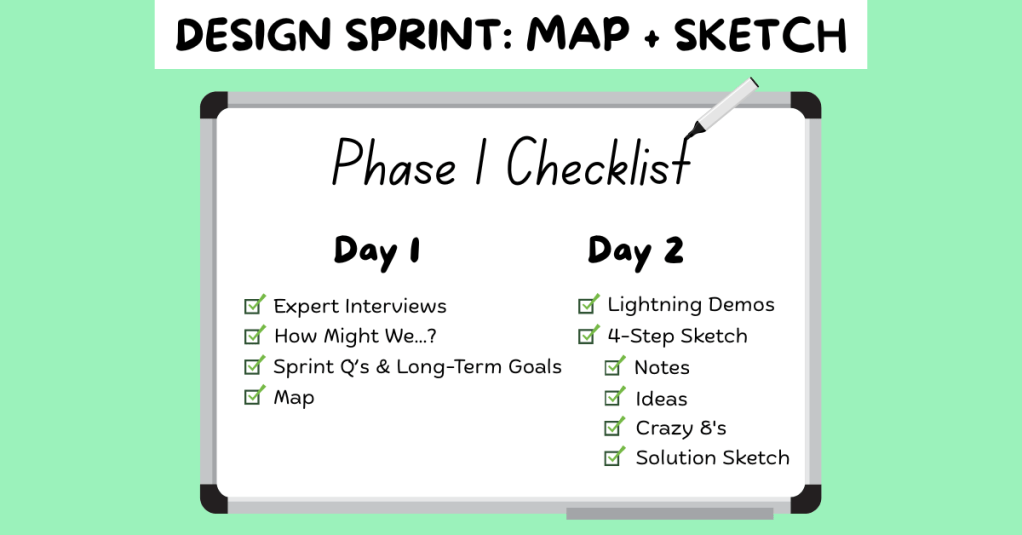
The past few weeks, you’ve done the preparation. You’re at the starting line of the race. Your teammates are beside you. No doubts. No fear.
You hear a loud, resounding “Go!” Your team takes off. The Design Sprint has officially begun.
Just like the start of a real race, the kickoff of a Design Sprint is full of momentum and possibility. You’ve spent time organizing roles, reviewing expectations, and understanding the problem you want to solve. Now, you begin the Map and Sketch phase. This is where you find your rhythm and start illustrating solutions.
What is the Map and Sketch Phase?
According to The Sprint Handbook: A Step-by-Step Guide to Planning and Running Innovation Sprints by Pattie Belle Hastings and Sprint: How to Solve Big Problems and Test New Ideas in Just Five Days by Jake Knapp, John Zeratsky, and Braden Kowitz, the first phase of a Design Sprint is about understanding your problem, defining goals, and developing ideas visually.
“In the Map and Sketch phase, you’ll learn how to dissect the problem space, gather insights, and set clear objectives for the work ahead.”
Pattie Belle Hastings
This phase is split into two days. Let’s explore what exercises you should conduct each day to start your Design Sprint in the best way possible.
Day 1: Create the Path
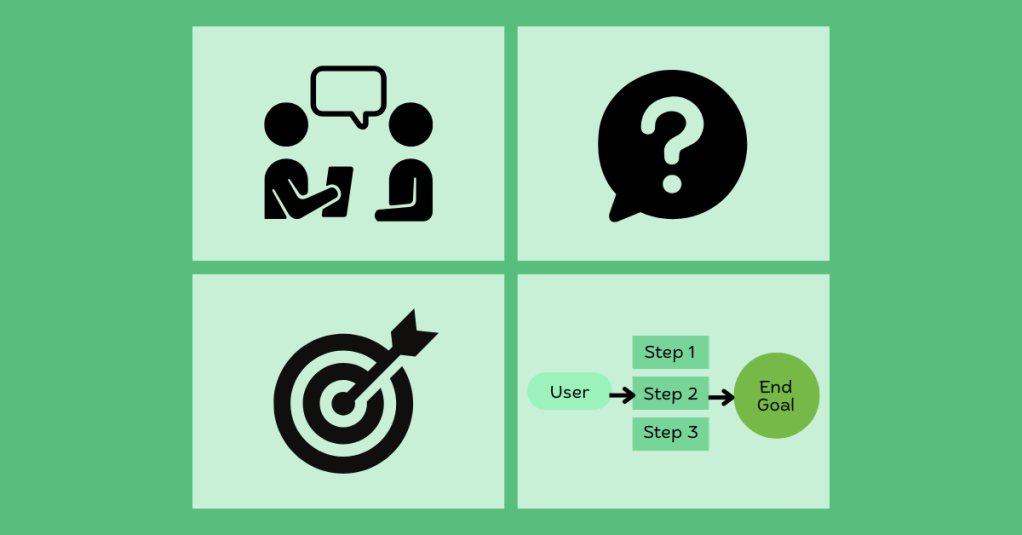
Your team begins by conducting short expert interviews with people who are experts with your proposed product. Getting insights from them will provide helpful background information and research for your project.
Example questions to ask experts include:
- What problem are we trying to solve?
- Who is currently using the product?
- What could this product look like in one to two years?
Next, identify your “How might we…?” questions. HMW’s help turn challenges into opportunities. Hastings recommends keeping these statements focused and specific for future brainstorming. An example of a “How might we…?” question could be:
How might we design an app that teaches Gen Z about personal finance management in an engaging and fun way?
Group your HMWs by theme, discuss them, and vote on the most important ones. This democratic method ensures that each voice is heard before narrowing your team’s focus.
Next, define your long-term goal. This helps align the group and set a clear vision for the product. Using sticky notes, each member writes their goals and presents them to the group. After discussion and voting, if a tie occurs, the Decider, your team’s final decision-maker, steps in to choose the final goals.
Sprint Questions are up next. These are potential roadblocks that your team could face when achieving the long-term goal(s). These questions are usually phrased as “Can we…?” statements:
Can we guide Gen Z users through their first financial task within five minutes?
Once shared and voted on, keep your top three Sprint Questions visible on a physical whiteboard or collaborative platform like Miro.
To wrap up Day 1, your team should create a product journey map. Knapp, Zeratsky, and Kowitz provide a few tips on creating an effective map:
- List the users, the people that will engage with your product, on the left.
- Write the end goal on the right.
- Use words and arrows between to illustrate the user flow.
- Keep it simple with less than twenty steps.
- Communicate with your team to make sure the map makes sense.
This map doesn’t need to be a work of art. It should depict the user’s journey and the steps between the starting point and the solution.
Day 2: The Solution Day
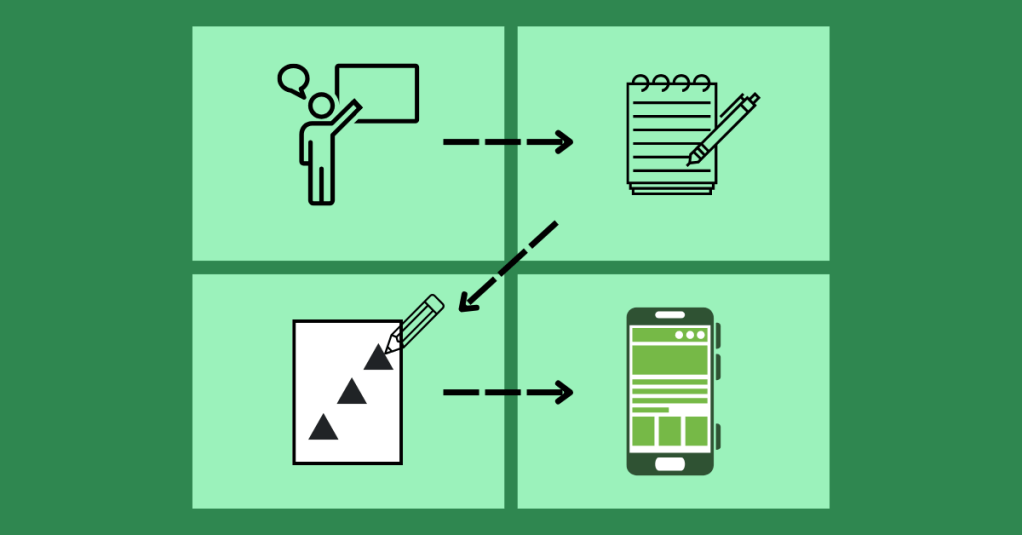
Now that the path is clear, it’s time to generate ideas.
Start with lightning demos. These are short presentations where team members share inspiration from existing products or solutions. Hastings suggests allowing 25 minutes for this step. Each team member shares three examples from current products that could influence or improve your project.
The next step? The Four-Step Sketch, which emphasizes quality thinking over artistic ability.
“On Monday, you and your team defined the challenge and chose a target. On Tuesday, you’ll come up with solutions… remix and improve… and sketch, following a four-step process that emphasizes critical thinking over artistry.”
Knapp, Zeratsky, Kowitz
Here’s the breakdown:
- Notes: Review and write down key takeaways from Day 1, such as the “How Might We…?” Questions, Sprint Questions, Long-Term Goal(s), and any other important information. Allow 20 minutes for this step.
- Ideas: Turn your notes into rough visual concepts. Dedicate another 20 minutes for the Ideas phase.
- Crazy 8’s: Fold a paper into eight boxes. Take one idea and sketch eight variations in eight minutes.
- Solution Sketch: Pick your strongest idea and draw more detailed versions.
When the Solution Sketches are complete, hold onto them and share them with your team the following day.
My Team’s Experience: Virtual and Collaborative
My team is conducting our Design Sprint virtually. For “Day 1” of this phase, we met on Zoom and worked together to identify the problem, create HMWs, define long-term goals and Sprint Questions, and draw our product map. We used a shared Miro board and sticky notes to collaborate in real time.
For “Day 2,” we split up to complete the lightning demos and sketches on our own, following the “together alone” approach. We regrouped by uploading our work to the Miro board and providing feedback. Even though we worked separately, we stayed in sync and communicated with each other.
To view my group’s Design Sprint progress, click here.
Final Thoughts: It’s Only the Beginning
What are some key takeaways from Phase 1 of the Design Sprint? Identify your direction before creating solutions, vote on everything to ensure everyone’s voice is heard, ask questions, communicate, and enjoy the Sprint.
We’ve only just begun, but the foundation we laid in the Map and Sketch phase sets us up for a strong sprint ahead. Just like a race, the energy you bring at the start can carry you far, only if you pace yourself, listen to your team, and stay open to change.
The Sprint has begun. We’re off running.
Stay tuned for the next phase of my Design Sprint journey.
 Christian Schaaf's Blog + Portfolio
Leave a comment