Creating an App: The Beginning Phase
This week, I was presented with a thought-provoking question: How do you create an app? And where do you start? As part of my graduate class on Ideation, Prototyping, and Testing, I was challenged to explore the beginning stages of app development. Until now, I had never considered creating my own app. Faced with this creative challenge, I wondered: Where do I begin?
I started by diving into the Ideation phase of the Design Thinking Process. This stage is all about generating ideas – the good, bad, and everything in between – to identify potential solutions to a problem. Through research, I discovered various Ideation techniques, including Brainstorming to Worst Possible Idea to Mind Mapping, and more. Ultimately, I decided to experiment with three techniques: Braindumping, Mind Mapping, and Sketchstorming. Here’s how each method shaped my app idea.
My Ideation Phase of Creating an App
Braindumping: Getting Every Idea on the Table
I began with Braindumping, a technique that involves writing down ideas freely without judgment or filtering. Using sticky notes, I jotted down responses to key questions: What are my interests? What do I look for in an app?
This exercise helped me identify four core interests: running, traveling, food, and dancing. I then brainstormed potential apps for each category.
- Running: A platform to connect with local runners or a personal coaching app.
- Dancing: A virtual dance studio offering live and pre-recorded lessons.
- Traveling & Food: An app that helps users find restaurants based on dietary preferences and allergies.
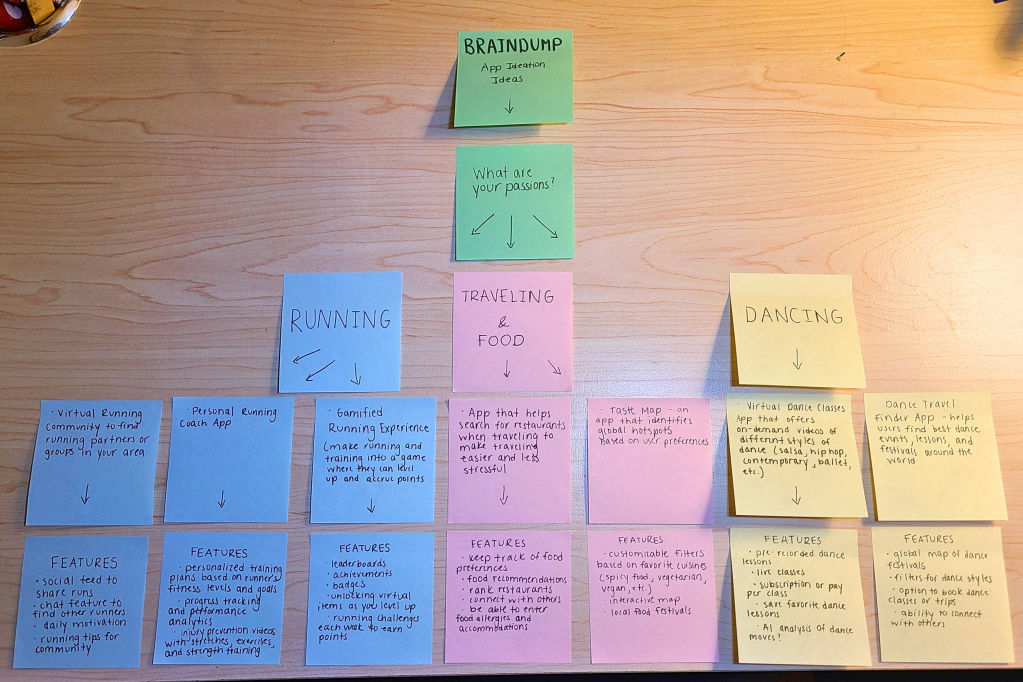
One idea resonated with me the most: an app that combines food and travel to help users find restaurants based on dietary restrictions. This concept stemmed from a personal experience with my mom; she follows a gluten-free diet and often struggles to find suitable dining options. With this in mind, I moved to the next phase: expanding the idea through Mind Mapping.
Mind Mapping: Structuring the Concept
To further develop my idea, I created a Mind Map, a technique where a central theme branches out into subtopics and related concepts. At the center of my map was the core idea: A restaurant-finding app for dietary preferences. From there, I created branches to explore the app in more detail:
- App Features
- Pages/Tabs
- Goals
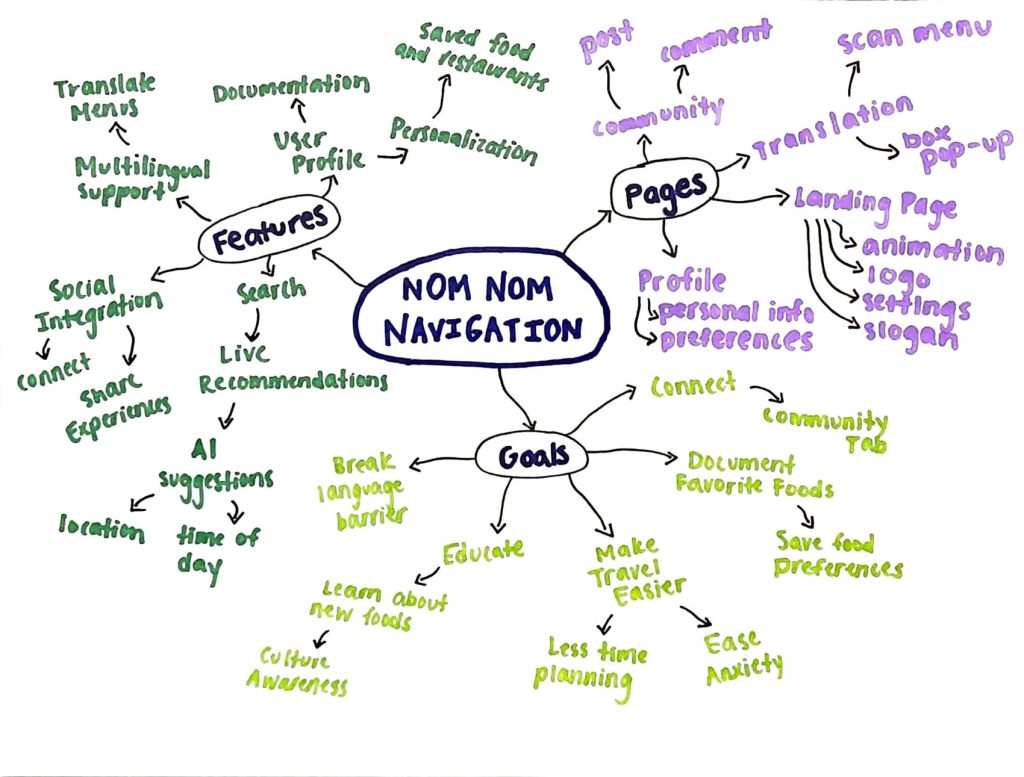
Mind Mapping allowed me to see the app’s potential features at a glance, providing clarity on what to include in some potential mockups. This led me to explore the Sketchstorming technique.
Sketchstorming: Bringing the Idea to Life
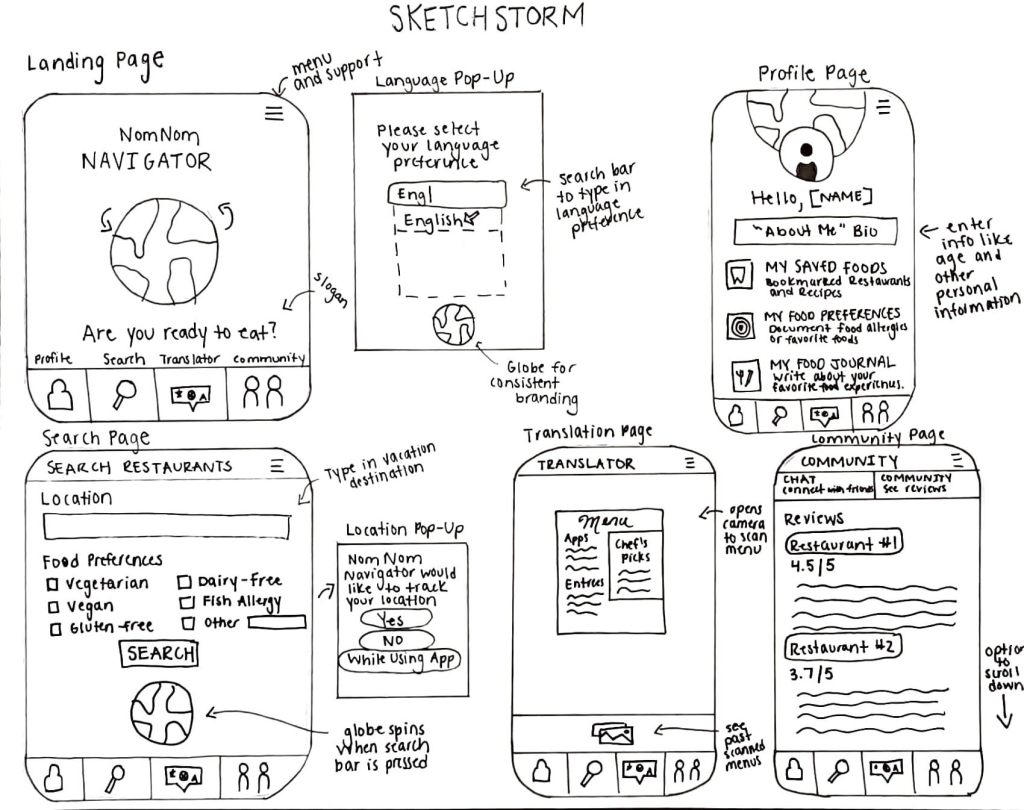
Sketchstorming involves quick, rough sketches to conceptualize a product’s interface and layout. I began by sketching the app’s landing page and main tabs:
- Profile: Where users input their dietary restrictions.
- Search: A customizable restaurant-finding tool.
- Translation: A language-assist feature for travelers.
- Community: A space for users to share restaurant recommendations.
Sketching helped me visualize the user experience, making the app feel more tangible. I realized that combining ideation techniques – starting broad with Braindumping, refining ideas through Mind Mapping, and visualizing them with Sketchstorming – was instrumental in shaping my concept.
Reflections and Next Steps
This was my first time formally using the Design Thinking Process, and it was both challenging and rewarding. By exploring multiple ideation techniques, I gained a deeper understanding of how to refine an idea and bring it to life. Moving forward, I’m excited to continue to study the Design Thinking Process.
Have you ever used an Ideation technique? I’d love to hear how you approach creative problem-solving!
 Christian Schaaf's Blog + Portfolio
Leave a comment