Giving up something in your daily routine is always a challenge. We’re creatures of habit, and, let’s be honest, change is tough. In a world that’s increasingly digital, we rely on our screens for connection, entertainment, and distraction. I know I do. So, this week, I gave up my favorite social media platform: TikTok.
Before diving into the experiment, I did what no one ever wants to do: look at their screen time. TikTok was my most-used app—by far. I wasn’t surprised. I love the creativity that TikTok brings to my feed—new recipes, travel inspiration, incredible artwork. But, like many of us, I’ve fallen victim to the infamous “doom scrolling.” What starts as 15 minutes can quickly turn into two hours of endless swiping. I thought to myself, “can I actually give up TikTok…and survive?”
For a week, I tracked two types of data: behavioral and emotional. On the behavioral side, I focused on how many times I reached for my phone, how long I spent on it, which apps I opened, and what I did to replace TikTok. Emotionally, I tracked how I felt each day, how productive I was, and whether I felt more present in my daily life.
Before starting the experiment, I reviewed my last three weeks of phone usage. In total, I spent 80 hours on social media—about 26-27 hours per week. TikTok accounted for 42 of those hours, averaging 14 hours a week. I was captivated by TikTok like a bug is drawn to light, but this was a wake-up call. I couldn’t justify saying, “I don’t have time to do that” anymore since I spent so much of my time on TikTok.
Inspired by Giorgia Lupi and Stefanie Posavec’s “Dear Data” project, I decided to approach my experiment in a similar way—tracking the data and then illustrating it with hand-drawn visuals.
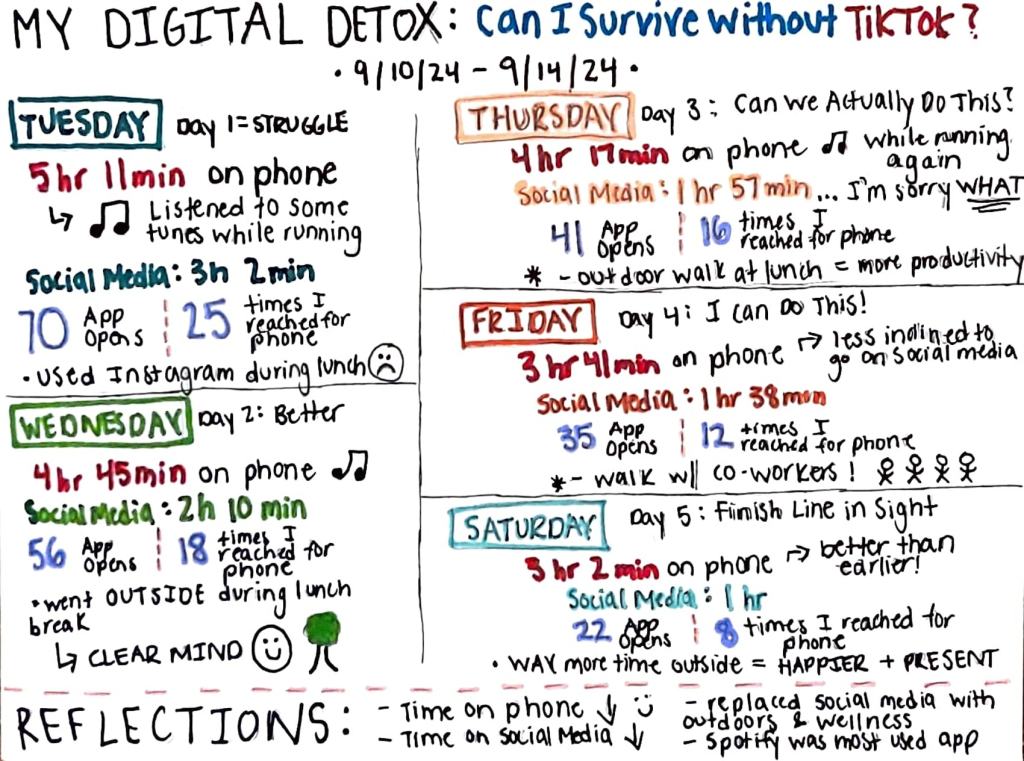
The first two days were the hardest. I kept reaching for my phone and accidentally tapping the TikTok icon out of habit. I also found myself using Instagram as a replacement for TikTok, but even that didn’t last long. By Thursday, I didn’t feel the need to check TikTok at all. I filled my time with walks during lunch and going to bed earlier.
By the end of the week, my phone usage had dropped significantly, and I was mostly using just Spotify. Without the constant comparison that comes with social media, my self-esteem improved. I was more focused at work and felt less distracted by notifications. I wasn’t losing time to what Hari describes as the “switch cost effect” in Stolen Focus. Instead, I felt genuinely happier because I was more productive and present.
Moving forward, I plan to continue this progress by setting social media time limits and taking my watch off during the day to avoid distractions. After completing this experiment, I now know that I can still function with less social media.
The question is, can you survive a TikTok detox?
 Christian Schaaf's Blog + Portfolio
Leave a comment